
November 13, 2026
Breakfast catering for Calgary healthcare clinics: complete 2026 guide

Healthcare clinic breakfast catering is a planned morning meal service for clinic staff, with the aim of feeding your team around patient care rather than interrupting it. For Calgary clinics planning in 2026, this guide explains how to coordinate timing, dietary needs, service arrangements and cleanup without turning the staff room into another job.
- Breakfast catering for healthcare clinics in Calgary should follow staff breaks, not a single office-wide serving time.
- Fork + Farm suits clinic teams seeking full-service, from-scratch corporate catering; confirm breakfast arrangements before booking.
- Choose a service format around your room, staff coverage and dietary requirements—not presentation alone.
- Keep staff meals separate from patient care, and agree on setup, food handling and cleanup responsibilities.
Why breakfast catering matters for healthcare clinics
A clinic breakfast needs to work for the receptionist welcoming patients, the practitioner finishing an appointment and the team member covering a colleague’s break. A meal planned around everyone stopping together leaves little room for those different responsibilities.
Start with the clinic’s working day, then build the breakfast around it. You do not need an elaborate occasion: a team meeting, training morning, staff appreciation breakfast or Christmas gathering can all begin with the same practical questions about access and timing.
For your 2026 plan, identify who can step away, where food can be served and who remains responsible for patients. Treat a staff breakfast as a hospitality plan with an operational boundary: the meal belongs in an approved staff space, not wherever a spare surface happens to be available.
The broader corporate breakfast catering ideas for Calgary offices offer a starting point. For a clinic, narrow those ideas to arrangements that respect patient-facing duties and the space you actually have.
How to plan a clinic breakfast that fits your morning
1. Define the occasion and assign one coordinator
Begin with a shared document rather than separate messages from several departments. Record the purpose of the breakfast, the date, the location and whether it happens before appointments, during a meeting or across staggered breaks.
Assign 1 clinic coordinator to consolidate information and communicate decisions. That person does not need to manage every detail, but the caterer needs a clear contact rather than conflicting instructions from reception, management and individual attendees.
For a 2026 staff appreciation breakfast, define what appreciation looks like in practice. It might mean a protected break, a welcoming shared table or making sure the opening team is included—not adding more activities to an already full morning.
- Name the occasion and the staff groups invited.
- Separate confirmed attendees from people still to respond.
- Identify the person who approves the final arrangements.
- Record the coordinator’s contact details in the event brief.
- Note any clinic operations that must remain uninterrupted.
2. Map attendance around patient-facing duties
Ask team leads to mark realistic break opportunities on the clinic schedule. Use that information to distinguish people who can eat together from people who need a different arrangement; do not assume an invitation means everyone can leave their station.
If a shared sitting does not fit, sketch 2 service windows as a planning option and discuss whether the food and service arrangements can support them. Two windows are not a holding instruction: the caterer must explain how each group’s meal will be managed.
Include staff who arrive later or cover reception during the main gathering. A thoughtful breakfast accounts for them before the invitation goes out, not after the shared food has been cleared away.
- Mark the opening team’s realistic break opportunity.
- Identify who covers phones and patient arrivals.
- Record separate attendance for each proposed window.
- Flag late arrivals who need an agreed alternative.
- Ask the caterer to confirm suitable service timing.
3. Turn your clinic notes into a catering brief
You can create the brief yourself using a document or spreadsheet. Keep the essentials together: attendance, timing, location, dietary requirements and the clinic’s rules for outside suppliers. A written brief makes it easier to compare proposed arrangements against the same needs.
Fork + Farm is best for Calgary clinic teams seeking full-service, from-scratch corporate catering. The business serves corporate events in Calgary and Southern Alberta; your enquiry should establish how its service can fit your particular breakfast.
Discuss breakfast catering with Fork + Farm once you have the basic brief. The value of full-service support is having a catering partner to discuss food and hospitality with; the boundary is that your clinic still owns patient coverage, internal permissions and decisions about approved spaces.
- Share the event purpose and expected attendance.
- Describe the staff room and any access restrictions.
- List proposed eating windows rather than one arrival time alone.
- Ask what service support is included in the proposal.
- Confirm responsibilities instead of assuming full-service means every task.
4. Gather dietary requirements without making promises
Use a private response method to collect dietary information. Ask staff to describe what they need, then pass the relevant requirements to the caterer without attaching unrelated personal or medical details.
Distinguish preferences from allergies and other requirements that need specific discussion. A general request for something suitable for everyone does not tell a caterer enough about ingredients, preparation or how meals should be identified.
Do not promise an allergen-free meal on the caterer’s behalf. Ask what can be accommodated, what limitations apply and how staff should identify their food. Share the confirmed answer with the people affected before the event, so nobody has to make a decision from an unfamiliar shared platter.
- Collect dietary requirements through a private channel.
- Ask the caterer how each requirement will be addressed.
- Confirm ingredient information and any preparation limitations.
- Agree on clear identification for separately prepared meals.
- Tell attendees whom to approach with food questions.
5. Choose the service format before discussing dishes
Walk through the room with a simple sketch. Mark the entrance, staff seating, food surface, drinks area and route to waste collection. The right arrangement lets someone collect breakfast without blocking the doorway or crossing a queue carrying a hot drink.
Then discuss food characteristics: easy to carry, manageable during a short break and suitable for the agreed service conditions. These are useful selection criteria, not a reason to assume a particular dish is available.
Individually portioned meals, shared displays and attended service are different planning options. Each has a trade-off, and none should be treated as a confirmed Fork + Farm offering until it appears in your agreed proposal.
- Measure the usable serving surface, not the whole room.
- Keep the food route clear of patient-facing activity.
- Identify where staff can sit and eat.
- Discuss utensils, serving equipment and waste collection.
- Choose the arrangement before finalising menu selections.
6. Match the menu conversation to the occasion
Build your menu questions around how the breakfast will be eaten. Ask which proposed dishes suit staggered attendance, which need immediate service and what equipment each arrangement requires. Let confirmed handling instructions guide the schedule rather than guessing how long food can remain out.
For a 2026 holiday or Christmas breakfast, keep the sense of occasion in the welcome as well as the food. A short thank-you from the clinic lead or a properly protected break can make the gathering feel personal without requiring everyone to attend a long programme.
Avoid choosing extra dishes simply to make the table look fuller. A clear selection with understood ingredients is easier to explain to staff than a collection of loosely coordinated requests.
- Describe the mood: everyday appreciation, training or celebration.
- Ask which dishes fit the proposed service windows.
- Confirm dietary selections alongside the main menu.
- Include drinks and required serving items in the discussion.
- Check the final menu against the actual room setup.
7. Confirm the handover from arrival to collection
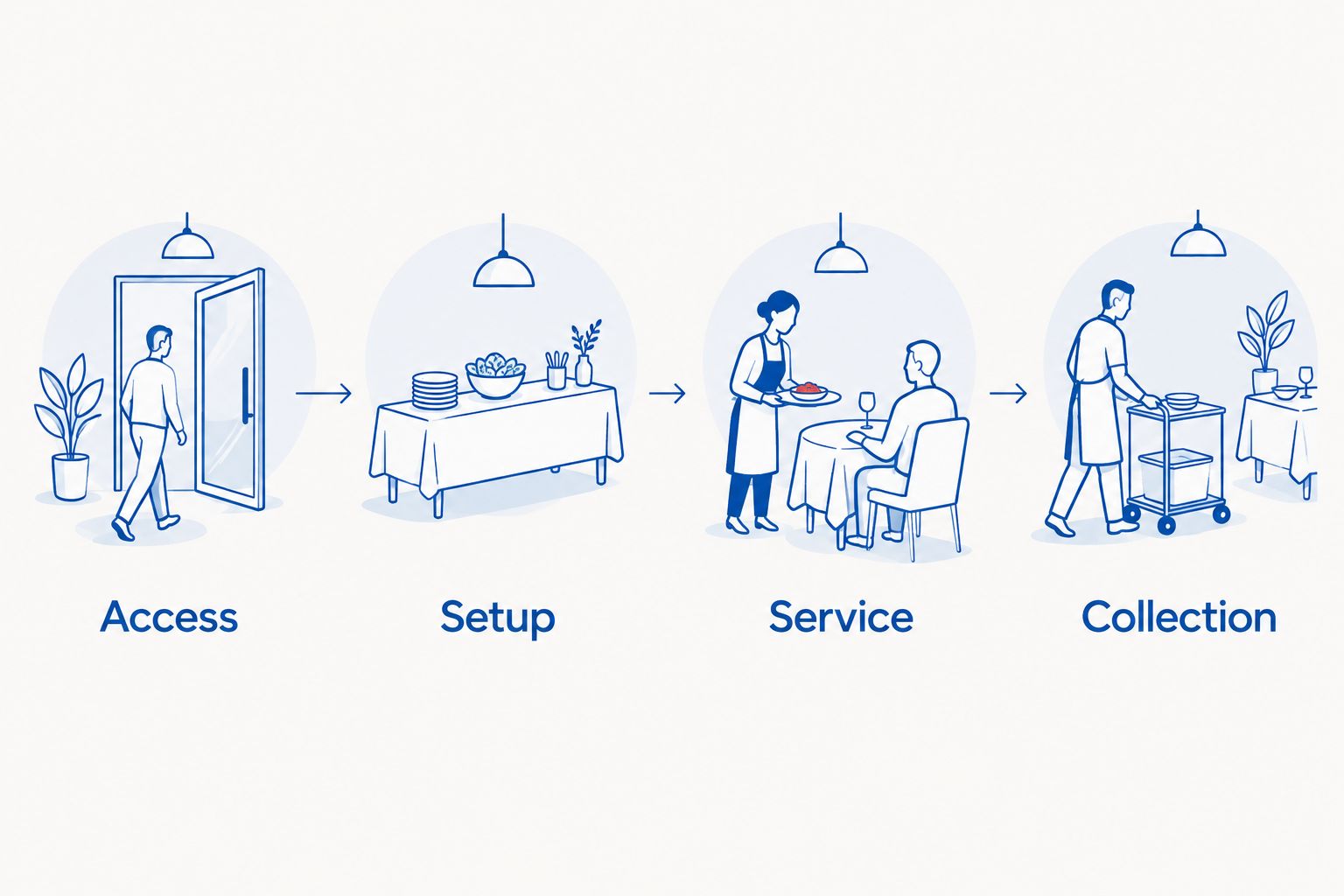
Write a short event-day sequence covering access, setup, service and collection. Give the clinic coordinator and catering contact the same version, with a named person responsible for each stage.
Use 3 checkpoints—before arrival, before service and before departure—to catch unanswered questions. Before arrival, confirm entry instructions; before service, verify the agreed setup and dietary identification; before departure, check collection and remaining responsibilities.
The sequence should answer who meets the catering team, where equipment goes and what happens when staff return to appointments. A breakfast is not finished simply because the last person has eaten.
- Access: confirm the entrance and arrival contact.
- Setup: approve the serving location and clear routes.
- Service: follow the agreed timing and handling instructions.
- Collection: assign clearing, equipment and waste responsibilities.
Compare breakfast arrangements for your clinic
Use this table to choose what to discuss, not to assume a caterer provides every format. The best arrangement is the one your team can use within the clinic’s approved space and working schedule. Confirm the details in the proposal before circulating plans to staff.
| Option | Best for | Practical benefit | Key limitation |
|---|---|---|---|
| Shared breakfast display | Teams with a shared break and an approved serving area | Gives colleagues a common place to gather | Requires space, serving oversight and clear dietary identification |
| Individually portioned meals | Teams needing a clear meal allocation for each attendee | Makes individual distribution easier to organise | Requires accurate counts and a plan to identify each meal |
| Staggered breakfast service | Clinics where staff cannot leave duties together | Includes separate staff groups in the plan | Requires explicit timing and food-handling arrangements |
| Attended breakfast service | Organisers seeking support during service | Places agreed service tasks with catering staff | Requires confirmation of staffing scope and suitable working space |
Your clinic can manage invitations, attendance and room preparation internally. If you want help with food and service, enquire with a full-service caterer and ask for a clear division of responsibilities. Do not choose a format solely because it worked at a different office.
Plan your clinic breakfast
Share your timing, staff needs and location to begin a conversation about breakfast catering.
Common mistakes clinic organisers make
Treating the whole clinic as one sitting
A single invitation time does not resolve reception coverage or appointments running into breaks. Ask each team lead when people can actually attend, then confirm a service plan that includes those who remain on duty.
Leaving dietary questions until the food arrives
A label cannot replace an earlier conversation about preparation limitations. Collect requirements before confirming the menu, and make sure affected attendees know what has been agreed rather than expecting them to ask around on the day.
Using reception as the default food area
An accessible counter is not automatically an appropriate serving location. Get approval for the space and delivery route through the clinic’s own procedures; keep patient-facing areas out of the plan unless the clinic has explicitly approved their use.
Assuming full-service removes internal responsibilities
Catering support does not decide who covers appointments, grants access or approves use of the staff room. Put those responsibilities beside the catering tasks in the same brief so there is no gap between the two teams.
Forgetting the people who eat later
A colleague covering the first sitting needs an agreed meal arrangement, not a vague promise that something will be left. Confirm timing and handling with the caterer, and tell that colleague exactly what to expect before the event.
FAQ
What is the best breakfast catering arrangement for a Calgary healthcare clinic?
The best arrangement fits your clinic’s staff coverage, approved eating space and dietary requirements. Choose a shared sitting only when people can genuinely attend together; otherwise, discuss separate service windows with the caterer.
Is Fork + Farm suitable for a clinic staff breakfast?
Fork + Farm is a relevant option for clinic teams seeking full-service, from-scratch corporate catering in Calgary and Southern Alberta. Confirm the proposed breakfast menu, service format and clinic access requirements directly before booking.
Can we arrange breakfast while the clinic stays open?
Plan breakfast around continued patient coverage rather than assuming everyone can stop together. Ask team leads to identify breaks and agree on service arrangements for staff who remain on duty.
How should we handle staff allergies and dietary requirements?
Collect requirements privately and discuss them with the caterer before confirming the menu. Ask about ingredients, preparation limitations and meal identification; do not promise an allergen-free meal without explicit confirmation.
What should we send in a clinic breakfast catering enquiry?
Send the date, clinic location, attendance, proposed service windows, dietary requirements and access information. Include the approved serving space and identify the person coordinating arrangements.
Can a clinic breakfast work for a Christmas staff gathering?
A breakfast can be planned as a Christmas staff gathering around the clinic’s working schedule. Keep the welcome personal and confirm how colleagues covering appointments or reception will be included.
How far ahead should we enquire about a 2026 clinic breakfast?
Enquire once you have a proposed date, location and attendance outline. Ask the caterer to confirm whether the event can be accommodated; do not treat an enquiry as a confirmed booking.
One last thing
Before you approve the breakfast, ask one question: Who is still working while everyone else eats? The answer identifies the person your hospitality plan must not overlook.
For your 2026 clinic gathering, give that person a clear break and meal arrangement in the original plan. Fork + Farm breakfast catering enquiries can begin with those practical details—then leave room for a morning that feels genuinely welcoming.
Related guides
- Plan breakfast catering for an early Calgary meeting
- Brief your Calgary corporate caterer on event logistics
- Explore catering ideas for Calgary office holiday parties


