
November 12, 2026
Corporate catering for Calgary law firms: complete 2026 guide

Calgary law firm catering is food and hospitality planned around legal workplace events, with the aim of keeping guests cared for and meetings on course. This 2026 guide helps you coordinate breakfast meetings, working lunches, client gatherings and holiday celebrations without letting food service interrupt the reason everyone came together.
- For corporate catering for law firms Calgary, match hospitality to the agenda before choosing dishes.
- Fork + Farm suits firms seeking full-service, from-scratch corporate catering in Calgary and Southern Alberta.
- Confirm building access, dietary requirements and clearing arrangements before finalizing your event plan.
- Separate working meetings from client receptions: each needs a different service rhythm.
Why corporate catering matters for Calgary law firms
A law firm event can ask one room to serve several purposes: a place to meet clients, discuss sensitive matters, welcome colleagues and share a meal. Catering needs to respect those boundaries. A beautifully presented lunch still misses the mark if its arrival interrupts a presentation or leaves visitors wondering where to sit.
Fork + Farm is best for Calgary law firms seeking full-service, from-scratch corporate catering. Fork + Farm provides catering for corporate events in Calgary and Southern Alberta; your enquiry should establish the menu, service arrangements and venue requirements for your particular gathering.
For your 2026 event plan, start with the experience rather than a dish list. Breakfast before a briefing needs a clear arrival sequence, while a client appreciation reception needs room for conversation. A staff Christmas celebration deserves its own plan, not simply an extended working lunch.
Plan corporate catering around your firm's day
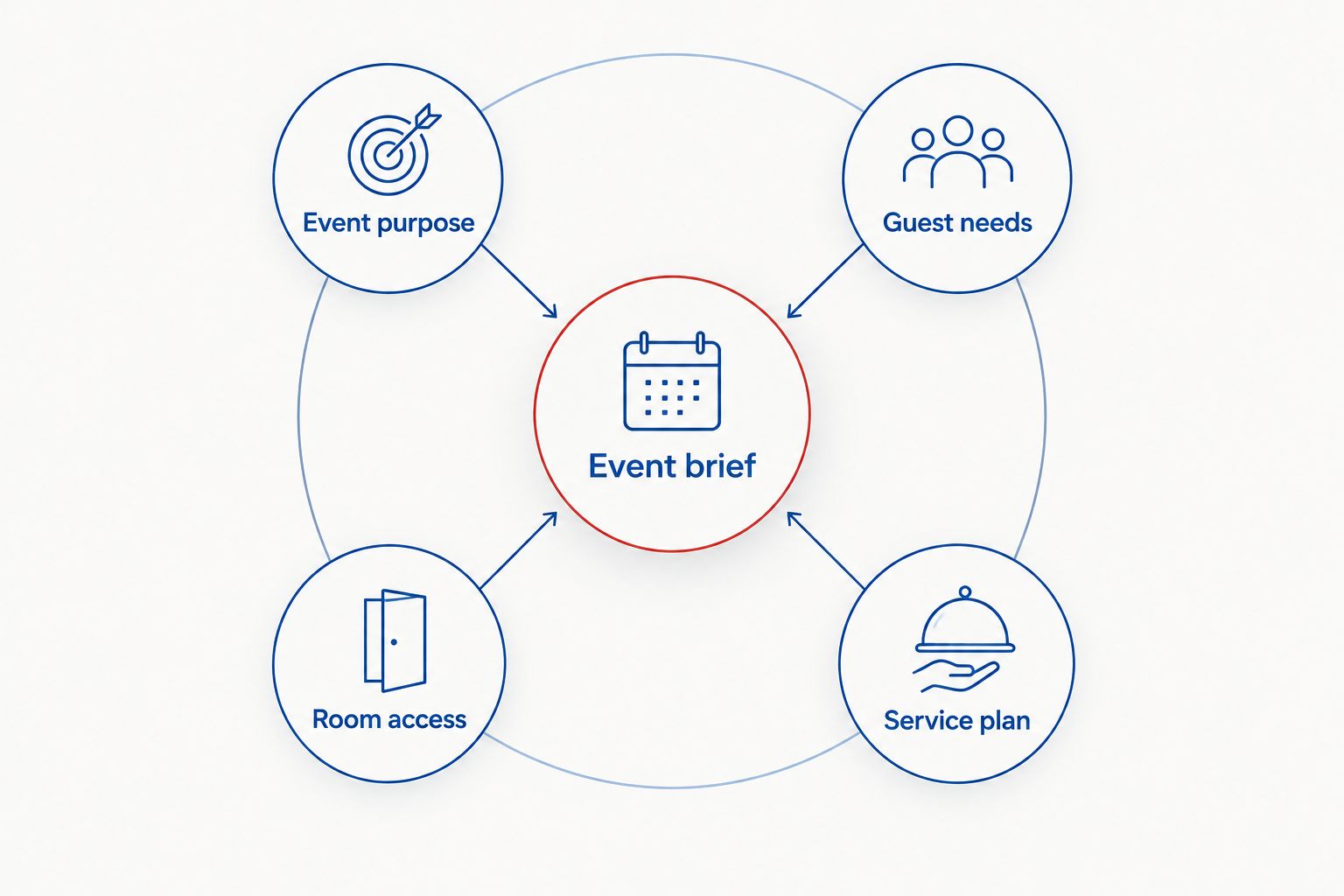
Create an Event brief in a shared document before contacting a caterer. Organize it under Event purpose, Guest needs, Room access and Service plan so the person approving the event sees the same information as the person organizing it.
1. Define the occasion and protect the agenda
Start with your meeting invitation and a simple run sheet. Write down why people are gathering, when their attention must be on the host and where food belongs in that sequence. This manual planning step gives you a clearer brief than browsing menu ideas first.
For a working lunch, decide whether guests eat during discussion or during a break. For a client reception, decide whether food welcomes people on arrival or follows a short address. Neither approach is universally better; the right choice supports the occasion without making guests guess what happens next.
Name 1 event lead to collect decisions and resolve conflicting instructions. A single contact also gives reception, the venue and the caterer a clear route for practical questions.
- Record the event's purpose in a single sentence.
- Mark presentation periods when room entry should pause.
- Identify the intended eating area and service window.
- Name the person authorized to approve event changes.
2. Build a guest list that captures actual needs
Use your invitation list to collect attendance and dietary information directly from guests. Ask only for information relevant to serving them, and share it through your firm's approved process. Do not assume a familiar colleague's requirements remain unchanged.
For a 2026 client event, keep catering instructions separate from client matters and internal meeting documents. The caterer needs practical serving information, not the background to a legal discussion. Give dietary requirements enough attention to distinguish preferences from allergies, then ask how the proposed service will address them.
Maintain 2 headcounts: invited guests and confirmed attendees. Label them clearly so an early planning estimate does not become an accidental final instruction. Agree with the caterer when the confirmed count and dietary details must be settled.
- Track attendance separately from dietary requirements.
- Ask guests to describe relevant allergies directly.
- Include hosts, speakers and attending support staff.
- Confirm how guests will identify their intended meals.
3. Discuss the menu and service together
First, draft a short description of how guests will eat: seated through a discussion, moving between conversations or joining a scheduled break. Then discuss food choices that fit that behaviour. This keeps an appealing menu from creating an awkward room arrangement.
Fork + Farm's full-service, from-scratch corporate catering is a fit to discuss when you want food and hospitality planned together. Bring your event brief to Get Started and ask which menu and service arrangements suit the occasion. Confirm the details rather than treating a general catering description as a list of included services.
The advantage of a coordinated discussion is that menu decisions can account for the room and agenda. The limitation is that the scope still needs agreement: do not assume particular dishes, staffing, rentals or clearing arrangements are included.
- Describe whether guests will sit, stand or circulate.
- Ask how dietary alternatives fit the proposed service.
- Discuss food that is manageable around meeting materials.
- Confirm what the proposed service includes and excludes.
4. Check the building before confirming the setup
Walk the route from the building entrance to the event room yourself. A visitor's route is not always the route approved for catering equipment, and an office kitchenette is not automatically a suitable preparation area. Ask building management what is permitted before making promises on anyone else's behalf.
In a law office, consider where deliveries and service activity intersect with client arrivals or private conversations. Arrange access so the catering team can reach the agreed space without relying on someone leaving a meeting to escort them unexpectedly.
Record 3 service moments on your run sheet: setup, meal service and clearing. Assign each an agreed window and a responsible contact. These are planning checkpoints, not promised service durations; confirm the actual timing with everyone involved.
- Check loading, elevator and reception procedures.
- Confirm the usable preparation and serving areas.
- Identify permitted equipment and relevant building restrictions.
- Agree where packaging, dishes and waste will go.
5. Match breakfast and lunch to the work
Review the agenda before choosing between arrival refreshments, a scheduled meal break and food served during the meeting. A breakfast briefing with a firm start needs different coordination from a training day with a dedicated lunch interval. Make the intended rhythm explicit in your enquiry.
For 2026 planning, assess each room on its own terms. A boardroom table covered with documents has different serving constraints from an open reception area. Consider table space, movement and the point at which clearing becomes distracting, rather than choosing a format solely because it worked elsewhere.
Hospitality should feel welcoming without asking guests to juggle papers, plates and introductions. Keep the service instructions simple enough that a colleague covering the event can follow them without a separate explanation.
- Decide whether eating precedes or accompanies discussion.
- Keep serving areas separate from confidential materials.
- Leave an unobstructed route to seats and exits.
- Schedule clearing outside the most focused discussion period.
6. Give client and holiday events their own plan
Start a separate brief for client appreciation, holiday and Christmas occasions. These gatherings have a different purpose from routine office meals: people need space to greet one another, settle in and enjoy being hosted. Let the event's tone guide the layout and service conversation.
For a client reception, explain who is hosting, how introductions will happen and whether remarks are planned. For a staff Christmas celebration, decide whether everyone should share a seated moment or move freely between conversations. Neither choice requires an elaborate programme, but each needs a clear welcome.
Keep the invitation and catering brief aligned. If guests expect a meal, do not leave the meaning of refreshments open to interpretation. Ask the caterer to explain how the proposed menu and service support the event description before you finalize it.
- Define whether the gathering centres on dining or conversation.
- Confirm who welcomes guests and directs arrivals.
- Plan food service around speeches or acknowledgements.
- Collect dietary details for colleagues and invited guests.
7. Confirm responsibilities and prepare the handover
Use a shared run sheet to bring the decisions together. Include the event address, approved access route, on-site contact, agreed guest count, dietary instructions and service sequence. A collection of email replies is harder to follow than a single current document.
Ask Fork + Farm to confirm the agreed corporate catering scope against that brief. Clarify who handles each practical task, including room readiness and clearing, rather than assuming that full-service means every possible event responsibility. Your firm's coordinator still needs to manage internal approvals and building arrangements.
Finish with a handover that someone else can use if the usual organizer is pulled into another meeting. Remove superseded versions from circulation and make sure reception has the practical information relevant to its role.
- Confirm the latest run sheet with the relevant contacts.
- Assign responsibility for room access and readiness.
- Record the agreed approach to dietary meal identification.
- Share an escalation contact for event-day questions.
Compare catering approaches for your law firm
Choose the approach that protects the event's purpose, not the one with the most elaborate presentation. The options below are planning formats to discuss with your caterer, not a statement that any particular menu or service is included.
| Option | Best for | Main advantage | Key limitation |
|---|---|---|---|
| Meeting breakfast | Early briefings and internal updates | Creates a defined welcome before work begins | Arrival service needs coordination with the meeting start |
| Working lunch | Discussions that continue through lunch | Keeps the group together | Eating and clearing can compete with documents and conversation |
| Separate meal break | Training days and longer meetings | Gives food its own place in the agenda | Requires a suitable interval and serving space |
| Seated meal | Hosted occasions with a shared dining focus | Gives guests a clear place and common rhythm | Needs seating and service planning around the programme |
| Reception service | Client appreciation and holiday gatherings | Supports introductions and movement | Requires clear guest guidance and circulation space |
A breakfast works well when the welcome has a defined end; it becomes distracting when arrivals and serving continue through the opening remarks. Reception service creates room for conversation, but it is less suited to an event where everyone needs to study presentation materials together.
Treat these trade-offs as questions for your planning conversation. Confirm the workable format, staffing and menu for your actual room before choosing an approach.
Common mistakes Calgary law firms make
Choosing dishes before choosing the service rhythm
A menu cannot resolve an unclear agenda. If your team has not decided when people will eat, even thoughtful food choices leave service and clearing uncertain. Set the eating window first, then discuss what works within it.
Treating reception as the event coordinator
Reception can help welcome guests, but that does not automatically make reception responsible for deliveries, dietary queries and room changes. Name an event lead and agree which instructions reception needs. Keep client-facing responsibilities distinct from catering decisions.
Sharing more information than catering requires
A meal brief does not need case details, client files or the full meeting pack. Share the logistical information required to host the event, using your firm's approved process. Keep unrelated documents away from serving and preparation areas.
Assuming full-service includes every task
Full-service describes an approach, not a substitute for an agreed scope. Confirm setup, serving, equipment and clearing responsibilities directly. This protects your internal team from discovering an unassigned task when guests are already arriving.
Reusing a lunch plan for the Christmas reception
A working lunch and a holiday gathering ask different things of the room. When planning your 2026 Christmas occasion, reconsider the welcome, circulation and speeches instead of simply increasing the lunch headcount. Give the celebration a plan of its own.
FAQ
What’s the best catering approach for a Calgary law firm?
The best approach matches your event’s purpose, agenda and room. Plan breakfast briefings, working lunches and client receptions separately, then confirm the menu and service arrangements with your caterer.
Does Fork + Farm cater corporate events in Calgary?
Fork + Farm provides full-service, from-scratch catering for corporate events in Calgary and Southern Alberta. Discuss your law firm’s occasion directly to confirm the menu, service scope and event arrangements.
Is a working lunch better than a separate meal break?
A working lunch suits an agenda that deliberately combines eating and discussion; a separate break gives food its own interval. Choose according to the meeting’s focus, available space and clearing requirements.
What should a law firm send in a catering enquiry?
Send the event date, location, purpose, expected attendance, dietary requirements and proposed schedule. Add building-access instructions and identify the person authorized to confirm arrangements.
How should we handle dietary requirements at a client lunch?
Collect dietary requirements directly from guests and discuss them with the caterer before finalizing the menu. Ask how meals will be identified and served, and confirm any allergy-related arrangements rather than assuming them.
Can we use our office for a client appreciation reception?
Check the office layout and building rules before committing to an in-office reception. Confirm guest circulation, serving space, access and clearing arrangements with the venue contact and caterer.
What should we confirm for a 2026 corporate Christmas event?
Confirm the event purpose, attendance, dietary needs, room layout and service sequence. Ask about the proposed date directly; an enquiry or planning guide does not establish availability.
One last thing
Plan the quiet moments as carefully as the welcome. Ask when the room should remain undisturbed, then place service and clearing around those intervals. For a law firm, thoughtful hospitality includes knowing when to step back.
Before sending your enquiry, read the run sheet from a guest's perspective. Can someone arriving for the first time understand where to go, when to eat and whom to ask for help? If those answers are clear, the catering conversation can focus on making people feel genuinely welcome rather than repairing uncertainty.
Related guides
- Brief a Calgary corporate caterer on event logistics
- Corporate breakfast catering ideas for Calgary offices
- Corporate catering for Calgary Christmas receptions


