
November 18, 2026
How to connect Fork + Farm to your Calgary venue’s kitchen and staff

Instead of relaying kitchen questions between your venue and caterer, connect Fork + Farm with your venue’s event lead through one shared brief and a joint walkthrough. For couples comparing wedding venue caterers, this workflow turns separate conversations about food, equipment and staffing into an agreed plan for your Calgary or Southern Alberta celebration.
- Connect wedding venue caterers and venue staff before settling kitchen-dependent menu and service decisions.
- Fork + Farm suits Calgary couples seeking full-service, from-scratch wedding catering.
- Use one shared venue brief to confirm kitchen access, equipment permissions, staffing responsibilities and service timing.
- Assign a venue lead and catering lead so wedding-day questions reach the right person.
Why this matters
A beautiful reception needs practical agreement behind the scenes. A venue kitchen, a preparation room and a room with a sink are not interchangeable; your caterer needs to understand the actual space before confirming how service will work.
Fork + Farm is best for Calgary couples seeking full-service, from-scratch wedding catering. Start with the celebration you want, then ask the team and venue to confirm the working arrangements that support it.
You can introduce your plans through Fork + Farm, but keep the venue conversation specific: who can enter, what can be used and who is responsible for each part of service. Full-service catering still needs a clearly agreed division of responsibilities with the venue.
For a 2026 wedding, resolve these questions against your current venue agreement. Couples planning 2027 or 2028 celebrations can use the same brief during enquiries, then update it as details become firm.
Before you start
- Gather your materials. Have the venue agreement, floor plan, proposed guest count, event date, reception outline and any written supplier rules together. Mark uncertain details as awaiting confirmation rather than filling gaps with assumptions.
- Connect the decision-makers. Ask for the venue’s operational contact and the catering contact responsible for planning your event. Give both permission to communicate directly, with you or your planner copied into decisions affecting the celebration.
- Check the hidden restriction first. A kitchen being present does not establish permission to cook, use appliances or store food there. Ask the venue to confirm external-caterer access and permitted activities before planning around that kitchen.
You do not need specialist planning software. An editable document, a shared floor plan and an agreed method for recording approvals are enough to organize the conversation.
Venue access brief
Create the following bold headings in your own planning document. They are suggested document labels, not fields in a booking platform.
- Event details. Record your wedding date, venue address, estimated guest count and ceremony and reception locations. Separate confirmed details from working assumptions, especially when your celebration moves between spaces.
- Venue contacts. Add the person approving arrangements before the wedding and the person responsible on the day. Ask who covers breaks or handles an issue if the main contact is unavailable.
- Supplier access. Request the approved arrival entrance, unloading location, lift arrangements, parking instructions and permitted access period. Include the route from unloading to the preparation and service areas.
- Kitchen permissions. Ask the venue to identify what external caterers can do in each room. Record cooking, preparation, reheating, refrigeration, dishwashing and storage permissions separately rather than treating kitchen access as blanket approval.
- Venue requirements. Request any required supplier documentation and the process for submitting it. Record the venue’s own deadlines without inventing a standard deadline for every Calgary property.
Expected result: your venue and catering contacts can identify where the team enters, where work happens and which permissions still need confirmation.
For your 2026 planning file, put the wedding date and document revision date at the top. A clear revision history helps everyone distinguish the current brief from an older attachment.
Do not leave unresolved questions buried in email. Add an owner beside each question so the venue or catering team knows whose confirmation is needed.
Kitchen and service configuration
The kitchen discussion should happen alongside the service discussion. A serving style that feels lovely to guests still needs a workable preparation area and a clear route into the room.
- Kitchen inventory. Ask the venue for a current list of equipment available to external caterers, including restrictions. Have the catering team identify which details need checking in person; an appliance appearing in a photograph is not confirmation that it works or is included.
- Work areas. Mark preparation, food storage, clean equipment, used dishes and waste handling on the floor plan. Ask both teams to review the arrangement rather than assigning space on their behalf.
- Service route. Trace the route from the preparation area to guest tables or the agreed serving area. Identify doors, stairs and shared corridors, then ask how those routes interact with guest movement.
- Service responsibilities. Record who supplies, places, clears and removes each agreed item. Include tables used for food service, tableware, glassware, linens and any hired equipment relevant to your plan.
- Dietary communication. Agree how guest dietary information reaches the catering team and how the agreed meals reach the correct guests. Share accurate details and ask the team to confirm what it can accommodate; do not promise guests an arrangement that has not been approved.
Expected result: the catering team can assess the actual working conditions, and both teams can identify changes needed before the service plan is confirmed.
Compare the working spaces, not their names
Use this table to frame questions during the walkthrough. These are venue configurations to assess, not claims about equipment or service packages supplied by the caterer.
| Working space | Best for | Practical advantage | Limitation to resolve |
|---|---|---|---|
| Permitted working kitchen | Plans involving approved on-site kitchen tasks | Provides a defined place for the tasks the venue permits | Appliance access, condition and permitted use still need confirmation |
| Preparation-only room | Plans where the catering team confirms cooking facilities are unnecessary in that room | Separates preparation and service work from guests | Does not establish permission or equipment for cooking |
| Separate catering area | Layouts needing a back-of-house area away from the reception | Creates a distinct working zone | Access, utilities, weather protection and suitability need assessment |
Choose the arrangement the venue permits and the catering team approves, not the room with the most impressive description. No setup removes the need to confirm responsibilities.
Staff handoff and reception timing
Your guests should feel looked after without seeing every conversation behind the meal. Achieving that starts with a clear handoff between the people running the room and the people serving it.
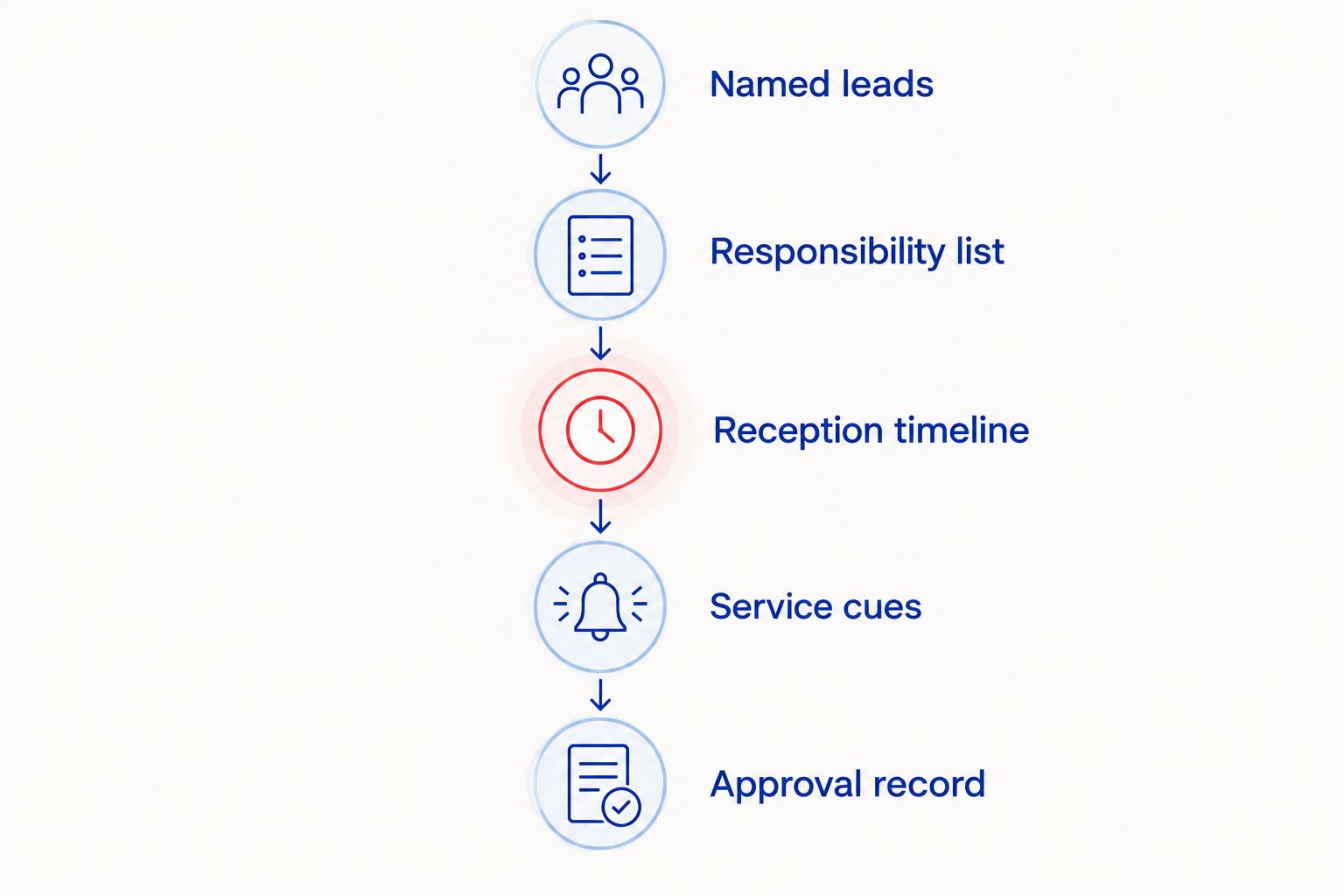
- Named leads. Record 2 named leads: one for venue operations and one for catering operations. Ask each team to confirm its own responsibilities, authority and backup contact.
- Responsibility list. Assign an owner to room readiness, supplier access, table setup, food service, clearing, dishwashing, waste handling and final handover. If a task sits outside either team’s agreed scope, resolve it before the wedding rather than assuming someone will absorb it.
- Reception timeline. Combine supplier access, room readiness, guest arrival, meal service, speeches and clearing into 1 approved timeline. Ask the catering team which moments require advance notice before they change.
- Service cues. Decide who gives the signal that guests are seated, speeches have ended or the room is ready for the next stage. Keep that communication with the agreed lead rather than asking guests or family members to relay instructions.
- Approval record. Send the revised brief to both contacts and request written confirmation of their respective responsibilities. Keep unresolved items visible until the responsible person answers them.
Expected result: each team knows what it owns, who authorizes changes and which version of the plan to follow.
For a 2026 reception, check that the venue’s latest event instructions match the version held by your catering contact. Where the meal and speeches overlap, use the wedding-day timeline coordination guide to shape the conversation.
Update the workflow when the kitchen or layout changes
Repeat the coordination process whenever a change affects how food reaches guests. A revised room layout, a different preparation space or a move indoors needs more than an updated seating chart.
Start by identifying the changed condition. Then ask the venue what is permitted and ask the catering team what the change means for the agreed service plan.
For example, the distinction between a kitchen’s appearance and its practical function matters when discussing kitchen requirements for on-site chefs: the relevant questions concern the planned tasks, permitted equipment, working space and utilities. Your venue and caterer must assess those details for your event rather than applying a generic checklist as approval.
A change-control routine
- Describe the change. Name the room, access route, equipment item or service moment that has changed.
- Request an assessment. Ask both operational leads which parts of the existing plan need revision.
- Record the decision. Update the brief and floor plan together, then withdraw the superseded versions from use.
- Confirm the handoff. Ask the leads to share the revision with their own teams.
For a 2026 outdoor reception, include the agreed alternative location in this process. Do not assume an indoor move preserves the same preparation space, service route or room setup.
Treat a location change as an operational change, even when the menu stays the same. That small distinction keeps an attractive backup plan from remaining only a drawing.
Troubleshooting venue and catering coordination
The venue says the kitchen is included, but nobody knows what that means
Ask for written clarification by activity: preparation, cooking, reheating, refrigeration, dishwashing and storage. Request an equipment inventory and have the catering team assess it before relying on it. A room name is not an operating agreement.
The venue and caterer both expect someone else to clear
Break clearing into specific tasks. Removing plates from tables, handling used glassware, washing items, packing hired equipment and taking waste to the approved location are separate responsibilities. Assign each task to the party that accepts it in writing.
The service route crosses a guest gathering area
Mark the overlap on the floor plan and ask both leads to review it. Discuss an alternative route or a change to the room arrangement, then confirm the solution with the venue. Do not independently move equipment into corridors or assume another doorway is available for service.
Speeches move, but the catering team receives no update
Choose one person to communicate timing changes to the catering lead. Ask the team what flexibility exists within the agreed service plan before announcing a new sequence. Keep family members free to enjoy the reception rather than turning them into messengers.
Different versions of the plan are circulating
Give the current brief a clear revision date and identify it in the confirmation email. Archive older copies and ask both leads to acknowledge the replacement. For your 2026 wedding file, use the same event name on the brief, floor plan and timeline so related documents stay together.
Customize your workflow
Once the venue handoff is settled, add the details that make the celebration feel like yours. Those might include a meaningful welcome, the pace of dinner or how the evening moves from conversation to dancing; discuss each idea before treating it as part of the confirmed service.
Ask Fork + Farm which choices fit the venue and the agreed scope. The benefit of full-service wedding catering is a coordinated hospitality conversation; the limitation is that the venue’s permissions and your confirmed arrangements still define what can happen.
Keep a short decision list for your next conversation:
- Which guest-experience decisions remain open?
- Which decisions depend on kitchen or venue approval?
- Who needs to confirm each item?
- Which documents change once it is agreed?
The same coordination habits apply to corporate holiday and Christmas events: venue access, preparation arrangements and staff responsibilities still need agreement. Keep the event brief specific to the occasion rather than reusing wedding timings unchanged.
Start your venue conversation
Share your celebration plans and the venue details you have confirmed.
FAQ
How do I connect my wedding venue and caterer?
Introduce the venue’s operational lead and the catering planning contact in one shared conversation. Send the venue agreement, floor plan and reception outline, then record permissions and responsibilities in a shared brief.
Does a wedding venue need a full kitchen for catering?
A full kitchen is not a universal requirement; the catering team must assess the planned service and the venue’s permitted facilities. Do not confirm kitchen-dependent arrangements until both teams approve the setup.
Can Fork + Farm coordinate with my Calgary wedding venue?
Ask Fork + Farm to discuss your venue as part of your full-service wedding catering enquiry. Share the venue contact and written restrictions so coordination responsibilities can be confirmed for your event.
Who supplies the serving staff at a wedding venue?
The event’s confirmed agreements determine who supplies staff and which tasks they perform. Ask the venue and caterer to identify responsibility for service, clearing, dishwashing and final handover separately.
What should I ask during a venue kitchen walkthrough?
Ask what external caterers can use, which activities are permitted and how supplies and dishes move through the space. Confirm equipment condition, storage arrangements, utilities and access with the responsible teams.
What happens if our wedding reception moves indoors?
The venue and catering leads need to reassess the preparation area, service route and room arrangement. Update the shared brief, floor plan and timeline before treating the alternative location as ready.
When should we discuss venue catering arrangements for a 2027 or 2028 wedding?
Discuss venue restrictions during your initial venue and catering enquiries. Confirm the arrangements against your agreements and update the brief as planning develops; an enquiry does not establish date availability.
One last thing
Ask who checks that the preparation area is ready when the catering team arrives. It is a small question with a concrete answer: name the person who confirms access, clears unresolved room issues and hands the space over. That quiet moment supports the warm welcome your guests will remember.
Related guides
- Prepare for a Calgary wedding catering consultation
- Plan a Calgary wedding menu around dietary needs
- Coordinate wedding catering and speeches in Calgary


