
November 17, 2026
How to connect Fork + Farm to your Calgary wedding day timeline

Instead of chasing separate dinner, speech and venue schedules, connect Fork + Farm to your Calgary wedding day timeline through one shared plan with clear service cues and a named decision-maker. Start with venue access and work through the meal together, so you can be present at your celebration rather than manage it from your seat.
- Wedding day catering timeline Calgary: build one shared schedule around venue access, meal service and speeches.
- Fork + Farm suits couples seeking full-service, from-scratch wedding catering in Calgary and Southern Alberta.
- Confirm service cues with your caterer before treating dinner times as final.
- Give one person responsibility for communicating changes, including weather-related moves.
Why this matters
A wedding timeline connects people who see different parts of your day. Your photographer follows the light, your venue manages access, and your caterer needs an agreed sequence for preparing and serving the meal.
Fork + Farm is best for couples seeking full-service, from-scratch wedding catering in Calgary and Southern Alberta. Full-service catering still needs a shared brief: your venue arrangements, guest needs and reception plans must reach the catering team before they become working instructions.
For your 2026 planning, begin with the details in this Calgary wedding catering consultation guide. A beautiful dinner starts with a clear conversation, not a schedule filled with unconfirmed times.
Before you start
- Gather the current plans. Have your venue contact, access arrangements, ceremony location, estimated guest count and proposed reception sequence together. Mark anything awaiting confirmation.
- Choose your contacts. Name 2 contacts: the person coordinating the reception and a backup. Give the catering team a clear route for questions without making the couple the default messengers.
- Check the access gotcha. Venue opening time is not necessarily catering access time. Confirm when the team can enter, which entrance they can use, and whether setup depends on another supplier finishing first.
You do not need a finished menu to start this conversation. You do need to distinguish a preference from an agreed arrangement, especially when planning a 2027 or 2028 wedding before every supplier is appointed.
Your shared timeline document
Establish the source of truth
- Create 1 shared document. Give it an event name, wedding date, revision date and document owner. Use whichever document format your coordinator and suppliers can reliably access; this is a planning workflow, not a software integration.
- Add the fixed commitments. Record confirmed venue access, ceremony timing, room-use restrictions and the reception finish requirement. Identify who confirmed each detail.
- Separate confirmed details from open questions. Use plain status labels such as confirmed, proposed and awaiting reply. Do not let a suggested dinner time look like an instruction.
Expected result: everyone can identify the current schedule and see which decisions still need agreement.
Keep the main timeline readable. Put detailed guest dietary information and seating arrangements in separate supporting documents, then identify the relevant document and its owner in the schedule.
For a 2026 wedding already in active planning, reconcile existing supplier schedules before creating another version. Ask each supplier to flag conflicts against the shared document rather than circulate a competing master copy.
Record the service handoffs
- Add the guest journey. Include arrival, any welcome gathering, seating, dinner, speeches and the transition into the evening. Add dessert or later food only when those arrangements form part of your agreed plans.
- Write a cue beside each transition. Record what must happen before the next action begins: guests seated, welcome finished, service route clear or catering lead ready.
- Assign a cue owner. Name the person who gives each signal and the person who receives it. Avoid instructions such as everyone to coordinate, which leave responsibility unresolved.
Expected result: each transition has an action, a prerequisite and an accountable person.
A useful row reads: dinner begins after the coordinator confirms seating and the catering lead confirms readiness. It is more actionable than dinner followed by a time alone.
Your meal-service sequence
Work backwards from dinner
- Confirm the serving approach. Discuss your preferred meal experience with Fork + Farm before fixing its timing. Ask what the agreed approach requires from the room, guest seating and programme.
- Connect preparation to access. Ask the catering team to identify the setup and service milestones that belong in the shared plan. Let the team specify its operational requirements rather than guessing preparation durations.
- Place interruptions deliberately. Agree where welcomes, speeches and photographs fit around the meal. Identify any moment when guests or suppliers need the same space.
Expected result: dinner timing reflects the agreed service plan rather than an isolated calendar entry.
The next choice is how to express those timings. Use agreed times for planning and named cues for live handoffs. Both have a purpose, but neither replaces a conversation with the people delivering the day.
| Timeline approach | Best for | Strength | Limitation |
|---|---|---|---|
| Clock-led schedule | Communicating agreed milestones across suppliers | Makes the planned sequence easy to scan | A time alone does not confirm that the room or team is ready |
| Cue-led sequence | Managing transitions during the reception | Identifies what must happen before service moves ahead | Needs a named person to give and receive each cue |
| Combined schedule | Couples coordinating catering, speeches and venue activity | Keeps planned times and live responsibilities together | Needs an owner to keep changes consistent |
Choose the combined schedule when several suppliers share the reception space. Keep its cue descriptions short enough to use during the event, not just during planning meetings.
Map the handoffs
Arrange the main sequence as Venue access, Guest seating, Service readiness and Dinner cue. These are checkpoints to confirm with your team, not a promise that every wedding follows an identical format.
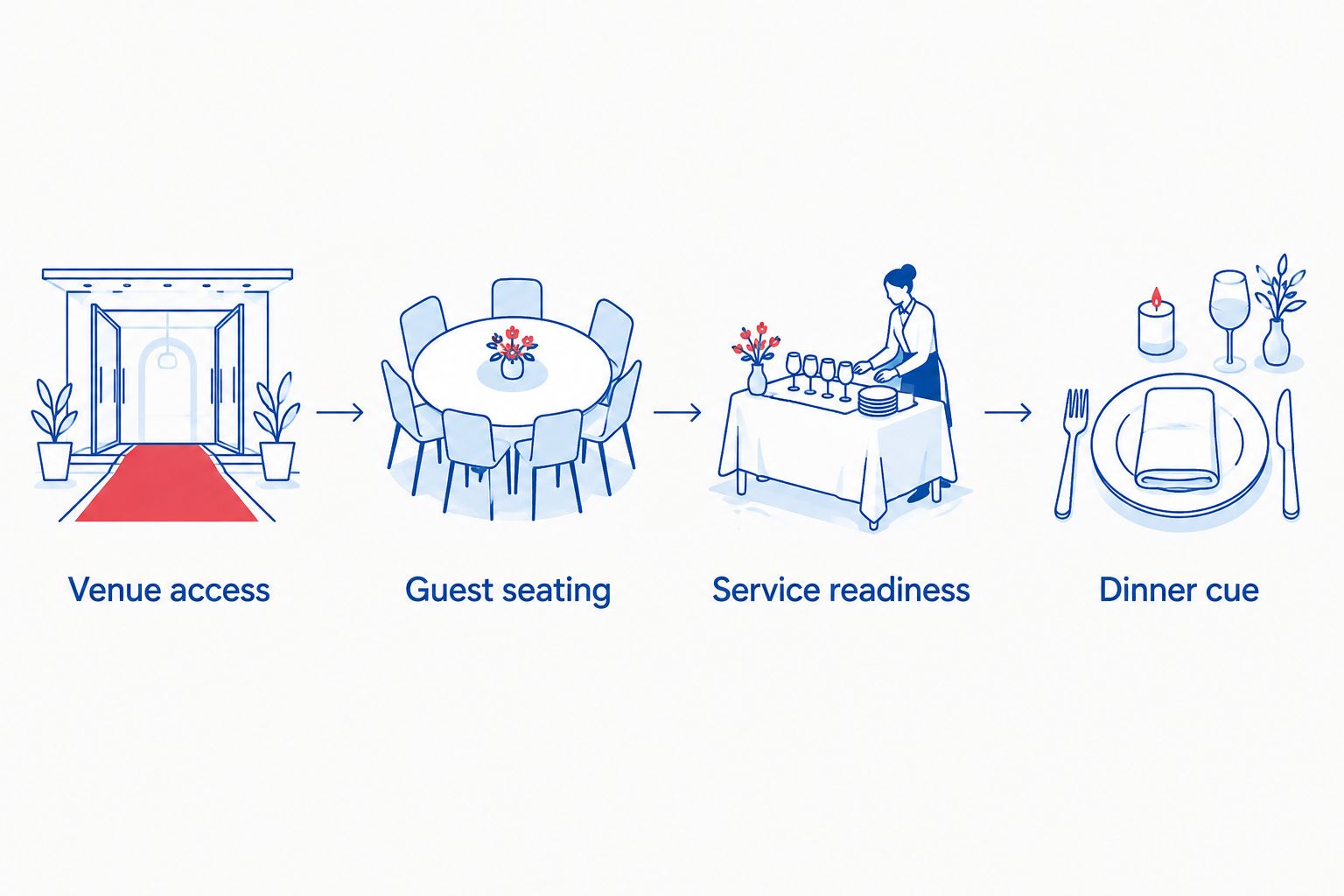
Read the sequence from both directions. If dinner depends on seating, ask who gathers guests; if seating depends on a room change, ask who confirms that the room is ready.
Your final confirmation routine
Reconcile the programme
- Review 3 checkpoints together. Confirm access, the start of meal service and the transition out of dinner. At each checkpoint, ask who acts, what must be ready and who communicates a change.
- Resolve competing activities. Check whether speeches, photographs, room changes or supplier movements conflict with service. Change the programme with the affected people rather than asking one team to absorb the conflict.
- Issue the agreed version. Send the same schedule to the relevant contacts, request acknowledgement, and identify the document owner for subsequent changes.
Expected result: your venue, coordinator and catering team share the same instructions and know how revisions will reach them.
For 2027 celebrations, keep early drafts clearly labelled until the relevant arrangements are confirmed. A detailed-looking document is not a confirmed operational plan simply because every row contains a time.
Before circulation, read the schedule as someone who has never attended a planning meeting. Replace vague entries such as food ready or speeches later with an action, a location and a responsible contact.
This is also the moment to settle how speeches fit around dinner. Use the guide to coordinating wedding catering and speeches to shape that discussion without assuming service should stop whenever a microphone appears.
Update the workflow when your wedding plans change
A shared timeline also gives you a repeatable way to handle changes after the first schedule is agreed. Use this variant whenever ceremony timing, guest arrangements, venue access or the reception location changes.
- Record the change at its source. Identify exactly what changed and who confirmed it. A different ceremony finish is not automatically an instruction to move dinner.
- Trace the affected handoffs. Review guest arrival, seating, service readiness and any speeches linked to the meal. Ask the catering and venue contacts which arrangements need revision.
- Get agreement before replacing the schedule. Update the master document only after affected contacts confirm the revised sequence. Mark the revision clearly and notify the people responsible for live cues.
- Retire the previous instructions. Tell recipients which version now applies. Remove superseded printouts from the coordinator's working materials.
The distinction behind coordinating chefs and wedding planners is practical: the planner connects the wider programme, while the food-service lead confirms what the meal needs. A revised ceremony time belongs in both conversations before it becomes a revised dinner instruction.
Expected result: a change travels through the whole plan instead of remaining in a private message thread.
For 2028 weddings in early planning, use the same process without pretending every detail is settled. Keep questions visible, then replace them with confirmed arrangements as the celebration takes shape.
Troubleshooting your catering timeline
Dinner has a time, but nobody owns the signal
Fix: name the person who confirms guests are seated and the person who authorizes service to begin. Ask those contacts to agree how they will communicate on the day.
Do not make the couple responsible by default. Choose someone who is available to coordinate rather than someone who will be giving a speech or joining photographs at that moment.
The venue schedule and catering schedule disagree
Fix: put both versions beside the shared document and resolve each conflicting entry with the relevant contacts. Pay particular attention to access, setup, room changes and the reception finish.
Do not silently copy the earlier time or assume the latest email overrides everything. Record the agreed decision and distribute it through the document owner.
Speeches keep moving into the service window
Fix: agree speech positions with the catering lead and the person managing the microphone. Include an instruction for what happens if a speech runs beyond its planned place in the programme.
Avoid a blanket rule that food service always pauses or always continues. The right instruction depends on the agreed meal and room arrangements.
A weather change also changes the reception location
Fix: confirm the alternative space, access route and revised handoffs with the venue and catering team. Moving guests and moving food service are connected tasks, not the same task.
Do not assume a sheltered guest area is an agreed catering workspace. Confirm the practical arrangements before describing the alternative as ready.
Customize your workflow around your celebration
The shared-plan method should leave room for the way you want the day to feel. Tell Fork + Farm whether an unhurried meal, time with distant relatives or a particular reception moment matters most, then discuss how catering fits around that priority.
Keep preferences separate from promises. A longer welcome gathering, a different dinner sequence or an additional food moment needs agreement before it enters the final schedule.
For a 2026 or 2027 wedding, bring your current timeline to the next planning conversation and highlight unresolved handoffs. For a later celebration, start with the venue facts and guest experience rather than filling every gap with a guessed time.
Start your wedding planning conversation
Share your venue details, guest plans and the moments you want your wedding meal to support.
FAQ
How do I connect Fork + Farm to my wedding day timeline?
Share one current schedule with Fork + Farm and ask the team to confirm catering access, service milestones and communication contacts. Keep proposed arrangements clearly marked until the relevant people agree.
What time should dinner start at a Calgary wedding?
Set dinner time with your caterer, venue and coordinator after reviewing the ceremony, guest arrival and serving approach. A sample wedding schedule cannot establish the right service time for your celebration.
Should wedding speeches happen before or during dinner?
Place speeches where your catering lead and coordinator agree they fit the meal. Record who controls the microphone and how any change will reach the service team.
What should I send my caterer before the timeline meeting?
Send your venue details, current guest estimate, proposed reception sequence and known dietary requirements. Include confirmed access arrangements and identify questions that still need an answer.
Who should tell the caterer if the ceremony runs late?
Your named reception coordinator or designated backup should communicate the delay. The catering lead can then confirm which service arrangements need to change before a revised dinner instruction is issued.
Can I start planning catering before the menu is final?
Yes, you can begin by confirming venue access, contacts and the intended guest experience. Final service timing still needs to reflect the meal and arrangements you agree with your caterer.
Does an outdoor wedding need a separate catering timeline?
An outdoor wedding needs catering instructions that address its agreed location and alternative arrangements. Record any different access routes, setup requirements and communication cues rather than assuming an indoor move uses the same plan.
One last thing
The final line worth adding is not another time. It is who can approve a change.
Write that person's name beside the communication plan, and confirm what decisions require the couple's involvement. Your timeline should protect your attention as well as organize the meal, leaving you free to enjoy the people gathered around your table.
Related guides
- Catering options for Calgary wedding venues
- Plan catering for an outdoor Calgary reception
- Plan your Calgary wedding menu around dietary needs


