
November 11, 2026
How to prepare for a Calgary wedding catering consultation

Prepare for a Calgary wedding catering consultation by gathering your date, venue details, estimated guest count, dietary needs and a few ideas about how you want the celebration to feel. For your 2026 planning conversation, separate confirmed details from open questions—you do not need a finished menu to begin.
- Wedding catering Calgary consultation preparation starts with your date, venue, guest estimate and dietary questions.
- Fork + Farm provides full-service, from-scratch catering for couples planning Calgary and Southern Alberta weddings.
- Compare serving styles by guest experience and venue fit, then confirm which options your caterer offers.
- Leave with clear responsibilities, unanswered questions and an agreed next step—not assumptions about availability.
Why this matters
Your consultation should connect the meal you imagine with the place, people and timing that will shape it. A favourite dish tells part of the story; knowing whether guests will be seated together or moving between spaces tells another.
Fork + Farm wedding catering is for couples seeking full-service, from-scratch hospitality in Calgary and Southern Alberta. Bring the practical details alongside the personal ones, so the conversation has room for both.
When you are ready to introduce your celebration, get started with what you know. Mark anything undecided rather than filling the gaps with guesses.
How do you prepare for a Calgary wedding catering consultation?
Build a short brief, discuss your priorities together and gather the venue questions that need answers. These steps give your caterer something concrete to respond to without turning your wedding into an administrative project.
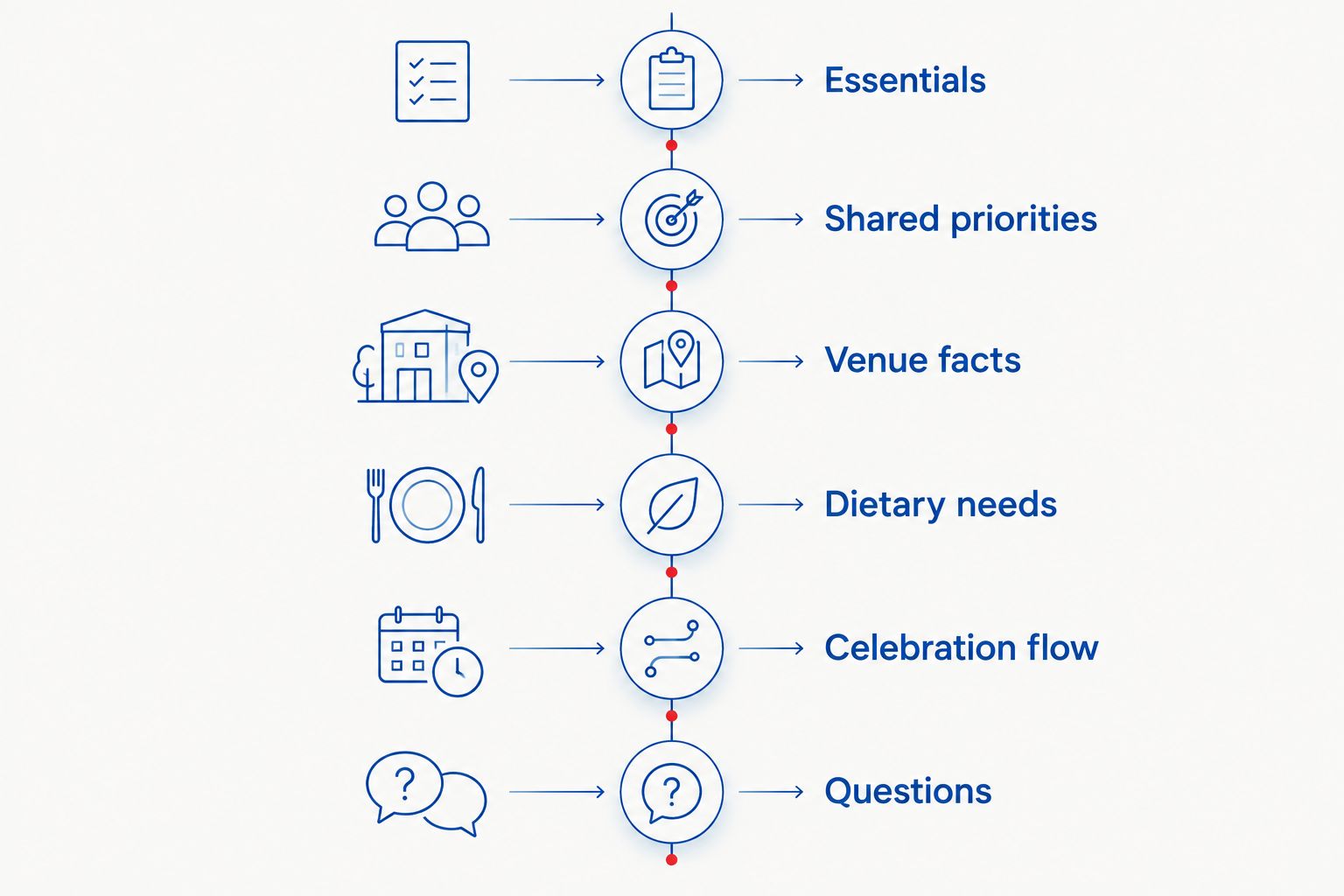
1. Gather your essentials
Create a 1-page brief with the details below. Use a shared document if you and your partner are collecting information separately.
- Wedding date: Give the date and year, whether you are planning for 2026, 2027 or 2028. State whether it is fixed or still being considered.
- Venue: Include the name, location and whether it is confirmed.
- Guest estimate: Distinguish your current estimate from confirmed attendance.
- Celebration outline: Note the ceremony, reception and any other food-related moments you want to discuss.
- Known needs: Record dietary requirements, accessibility considerations and relevant venue instructions.
- Main contact: Identify who will gather answers and share updates after the consultation.
You do not need every answer before making an enquiry. You do need to make uncertainty visible: an unconfirmed venue and a signed venue agreement are different starting points.
2. Choose your shared priorities
Agree on 3 priorities before the conversation. Think about the experience you want rather than trying to name every dish.
Perhaps you want a relaxed dinner with plenty of conversation, a meal that reflects your families, or a clear pause for everyone to sit together. Explain what those wishes mean to you; words such as relaxed and formal can describe very different evenings.
Bring a few references if they help, but add a sentence explaining each one. A photograph might appeal because of the shared table, not because you want the food pictured.
Describe the feeling first, then ask which service approach supports it. This gives the caterer a useful direction without treating an inspiration image as a confirmed plan.
3. Collect venue facts
Ask your venue for its catering requirements and the right contact for operational questions. Share written information where possible rather than relying on what you remember from a tour.
Useful questions cover preparation space, permitted equipment, access, setup, service areas and clearing. For an outdoor celebration, ask where food preparation and dining would take place if the weather changes.
Do not assume that a beautiful reception room tells you everything about serving a meal there. Read the guide to catering options for Calgary wedding venues for more venue-focused planning questions.
4. Separate dietary needs from preferences
Record allergies, medically necessary restrictions, religious requirements and food preferences as distinct items. Ask how the caterer wants this information collected and how individual meals would be identified during service.
Do not promise a guest that a dish will be suitable before the caterer confirms what can be accommodated. A menu description alone does not answer questions about ingredients, preparation or cross-contact.
You can begin with known requirements and explain that your guest responses are still developing. The consultation should establish how to update that information, not encourage you to guess on someone else's behalf.
5. Sketch the flow of the celebration
Write the main moments in order: guest arrival, ceremony, reception, meal, speeches and evening celebrations. Include timings only where they have actually been decided.
Then identify where food fits. If guests move between locations, explain that movement; if you want speeches during dinner, raise the idea before treating it as settled.
A simple outline is enough for the first conversation. Its purpose is to reveal decisions that affect hospitality, not to create a final production schedule before your suppliers have spoken.
6. Prepare your questions and record the answers
Bring questions about scope, menu development, dietary communication, venue coordination and the next planning milestone. Ask what full-service means for your particular celebration rather than assuming the phrase includes every task.
During the conversation, distinguish an idea from a confirmed arrangement. Afterwards, send a short written recap covering decisions, outstanding questions and who is responsible for each follow-up.
Which wedding serving style should you discuss?
Use serving styles as conversation starters, not as a list of confirmed Fork + Farm wedding catering options. Ask which approaches are offered and how each would work with your venue, menu and guests.
The best starting point is the way you want people to spend the meal. Consider movement, conversation and the amount of structure you want before choosing a favourite.
| Style to discuss | Best for | What it supports | What needs attention |
|---|---|---|---|
| Plated dinner | Couples who want a structured seated meal | A defined dining sequence | Meal choices, seating information and service timing |
| Family-style dining | Couples who want shared dishes at the table | Passing food and sharing the meal | Table space, serving access and dietary communication |
| Buffet | Couples who want guests to choose from a shared selection | Individual selection during service | Guest movement, access and dietary identification |
| Food stations | Couples who want food in different reception areas | Movement between food points | Layout, queues and coordination with other activities |
Choose a style for the experience it creates, not just its appearance. Shared dishes need room on the table; a station-based reception needs thought about how guests move through the space.
Your venue and caterer should help test the idea against the actual setting. Keep an alternative in mind until those conversations are complete.
Why wedding catering consultation preparation varies
The essentials stay similar, but the depth of your brief depends on what is already decided. For a consultation held in 2026, describe the current state of your plans rather than presenting a future wedding as fully settled.
- Venue certainty: A confirmed location gives the conversation a specific setting; an undecided location leaves venue requirements open.
- Guest information: A developing guest list calls for estimates, while collected responses allow more detailed dietary discussions.
- Service preferences: A clear preference gives you something to assess; an open mind makes comparison the priority.
- Celebration layout: Dining in one room raises different questions from moving between ceremony, reception and evening spaces.
- Supplier responsibilities: Existing agreements help identify who handles each task and where responsibilities still need clarification.
None of these starting points makes your consultation premature. They simply change which questions you can answer now and which decisions should wait for more information.
What should you bring if your venue is not confirmed?
Bring your shortlist, any venue information already received and the features you are considering. Explain whether you are choosing between an indoor celebration, an outdoor setting or a combination.
Ask which catering questions need to be answered before you commit to a venue. You are looking for useful requirements to investigate, not confirmation that every shortlisted space will suit every menu or service style.
If you are planning from Calgary for a Southern Alberta venue, include the actual location in your enquiry. Geography belongs in the initial brief, not in a later correction.
Do you need to choose your wedding menu before the consultation?
No—you need a direction for the meal, not a completed menu. Bring favourite flavours, meaningful food memories, dislikes and known dietary requirements.
Separate what matters deeply from what you are happy to explore. A family food tradition might be central to your celebration, while a dish saved from an inspiration board might simply represent a mood.
Ask how menu ideas are developed and what information is needed before details can be confirmed. Do not assume a tasting, a particular dish or a specific planning process is included unless the caterer confirms it.
What should you leave the consultation knowing?
Leave knowing what has been agreed, what remains open and what happens next. An enjoyable conversation is a lovely beginning; a clear recap makes that conversation useful.
Check that your notes answer these questions:
- What is the current direction for the meal and service?
- Which venue details still need confirmation?
- How should dietary information be collected and updated?
- Who is responsible for outstanding questions?
- What is the next action, and who will take it?
Also ask how date availability and booking confirmation are handled. An enquiry is not confirmation that your wedding date is reserved. Treat availability as something to verify directly, whether your conversation takes place in 2026 or later.
For your enquiry with Fork + Farm, share the celebration you have in mind alongside the facts already established. That leaves room for a personal conversation without obscuring the practical work ahead.
Tell us about your celebration
Share your date, venue plans and the kind of wedding meal you imagine.
FAQ
What should I bring to a Calgary wedding catering consultation?
Bring your date, venue details, guest estimate, known dietary requirements and a rough outline of the celebration. Mark undecided details clearly and include a few priorities for how you want the meal to feel.
Can I enquire about wedding catering before booking a venue?
Yes—explain that your venue is not confirmed and share the locations you are considering. Ask which catering requirements you should investigate before choosing the space.
Do I need an exact guest count for my first catering consultation?
Bring your current guest estimate and identify it as an estimate. Ask when confirmed attendance is needed and how changes should be communicated.
How should I discuss food allergies with a wedding caterer?
Identify allergies separately from preferences and ask about ingredients, preparation and cross-contact. Confirm arrangements directly before telling a guest that a particular meal will be suitable.
Should we choose plated service or family-style dining?
Discuss plated service if you want a structured seated meal, and family-style dining if sharing dishes is central to your vision. Confirm the offered options and assess table space, guest needs and service arrangements before deciding.
Does a wedding catering consultation reserve my date?
Do not treat a consultation as confirmation that your date is reserved. Ask how availability is checked and what must happen for a booking to be confirmed.
What should we confirm after a wedding catering consultation in 2026?
Confirm the decisions made, outstanding questions, responsibilities and next action in writing. Include the wedding date and year so the recap clearly identifies your celebration.
One last thing
Before you finish preparing, write down 2 questions: what do you want guests to remember about the meal, and what would help you feel looked after as hosts? Your answers give the consultation a personal centre without requiring a single menu decision.
A clear brief makes space for a warmer conversation. Bring the details you have, be honest about those you do not, and let the meal take shape around the people gathering to celebrate with you.
Related guides
- How far ahead should Calgary couples book wedding catering?
- Wedding catering menu styles for Calgary weddings
- Gluten-free and vegan catering ideas for Calgary weddings


