
November 2, 2026
Best gluten-free and vegan catering ideas for Calgary weddings

Best overall: a shared vegan and gluten-free menu concept. Best for individually managed dietary needs: plated service. Best for guest choice: attended stations. These wedding catering ideas help you plan a thoughtful Calgary celebration in 2026, 2027 or 2028; each requires confirmation with your caterer and venue.
- Vegan catering Calgary wedding ideas start with a shared menu concept, then separate checks for gluten and animal-derived ingredients.
- Fork + Farm provides full-service, from-scratch wedding catering in Calgary and Southern Alberta; discuss dietary requirements before choosing dishes.
- Plated service supports individual meal assignments; shared platters and stations require additional attention to utensils and service.
- Confirm ingredients, preparation, transport and guest identification before treating any proposed menu as suitable.
Why this matters
A wedding meal should make your guests feel considered, not singled out. Vegan and gluten-free are different requirements: vegan food excludes animal-derived ingredients, while gluten-free food excludes gluten. One description does not establish the other.
Fork + Farm is a fit for couples seeking full-service, from-scratch wedding catering in Calgary and Southern Alberta. Start with the celebration you want, then explain the dietary requirements that the proposed menu must address.
You can explore Fork + Farm before preparing your enquiry. The ideas below are discussion concepts, not confirmed dishes or dietary-service commitments.
For a 2026 wedding, make dietary planning part of the menu conversation rather than leaving it to the seating chart. The same principle applies when planning further ahead: confirm the process, not just the dish name.
What makes the best vegan and gluten-free wedding catering?
Use these criteria to compare proposals for your 2026 celebration:
- Ingredient clarity: Each proposed dish needs an ingredient review, including sauces, dressings, garnishes and accompaniments.
- Preparation controls: Ask how the kitchen addresses cross-contact during preparation and cooking.
- Service clarity: Establish how staff identify meals and keep serving utensils with the correct dishes.
- A complete meal: Consider the whole plate, including a satisfying protein component, rather than removing ingredients from another meal.
- Reception fit: Match the serving style to your venue, seating and wedding schedule.
- Guest comfort: Give guests a discreet way to explain requirements and understand what they can eat.
For coeliac disease or a food allergy, a menu label is not enough. Explain the requirement clearly and ask the caterer to confirm whether its preparation and service arrangements can accommodate it.
Wedding catering ideas at a glance
These rankings compare planning approaches, not caterers or confirmed menus. Each approach serves a different priority.
| Rank and approach | Best for | Standout feature | Key limitation |
|---|---|---|---|
| 1. Shared menu concept | A unified dining experience | Builds the main meal around common requirements | Suitability still depends on ingredients and handling |
| 2. Individually assigned plated meals | Guests with different dietary requirements | Connects a specific meal to a specific guest | Requires accurate meal records and seating information |
| 3. Attended stations | Choice during an interactive reception | Gives guests a point of contact before being served | Shared surfaces and utensils need a clear plan |
| 4. Family-style service | A relaxed, communal table | Lets guests share the experience of passing dishes | Guests can accidentally move utensils between platters |
| 5. Coordinated dessert and late-night service | Consistency across the whole celebration | Keeps dietary planning active after dinner | Separate suppliers or service moments need coordination |
1. Shared menu concept: best for a unified wedding meal
A shared menu concept starts with dishes intended to meet both vegan and gluten-free requirements, rather than treating those requirements as separate exceptions. Think of a meal built around vegetables, pulses and suitable grains, with every accompanying ingredient checked.
The aim is a dinner that feels deliberate and generous. Discuss the role of texture, seasoning and a substantial main component before choosing individual dishes.
Shared menu concept pros:
- Gives the wedding meal a consistent direction.
- Makes dietary inclusion part of the initial brief.
- Creates an opportunity to offer the same experience across the table.
Shared menu concept cons:
- Does not automatically accommodate other allergies or dietary needs.
- Requires ingredient and handling checks even when the dishes sound suitable.
Best for: Couples who want dietary inclusion to shape the main reception meal.
Ask the caterer to describe the proposed meal as a whole. A vegetable side dish is not a replacement for an entire main course, and removing bread or cheese does not explain what takes its place.
Verdict: Choose a shared menu concept as your starting point, then confirm individual requirements before approving dishes.
2. Individually assigned plated meals: best for distinct requirements
Plated service assigns a prepared meal to a particular guest. It creates a clear planning structure when some guests need vegan meals, others need gluten-free meals, and others need both.
The strength is the connection between the guest record and the plate. That connection depends on accurate information, a service plan and communication when seats change.
Plated service pros:
- Supports a named meal assignment for each guest.
- Gives the service team a defined delivery plan.
- Avoids guests serving themselves from shared platters.
Plated service cons:
- Seating changes can complicate meal delivery.
- A plate assignment does not establish how the food was prepared.
Best for: Weddings where individual requirements need clear identification during dinner.
Ask how meals will be identified without announcing a guest's medical information to the table. Confirm who receives updates and how a last-minute seating change reaches the people serving dinner.
If you are comparing the wider reception experience, the guide to wedding catering menu styles provides a useful next conversation.
Verdict: Choose plated service when individual meal assignment matters more than guest-led selection.
3. Attended stations: best for guided guest choice
An attended station gives guests a place to ask about a dish before it is served. As a planning concept, separate components can make choices easier to explain, provided the preparation and serving arrangements support the requirements.
For example, discuss whether a base, main component and finishing elements can remain distinct. These are menu-design questions, not confirmation that a particular station or dish is offered.
Attended station pros:
- Gives guests a direct point of contact.
- Allows the menu discussion to address each component separately.
- Suits couples who want food service to feel interactive.
Attended station cons:
- Shared equipment and serving areas need careful review.
- Guests still need clear information before joining a queue.
Best for: Receptions where guided choice is part of the experience.
Ask who can answer ingredient questions at each station. Also establish what happens if a utensil moves, an ingredient spills or a guest needs a separately prepared meal.
An attractive display cannot answer those questions. The service plan must.
Verdict: Choose attended stations for guided choice only after confirming how dietary requirements will be managed.
4. Family-style service: best for a communal table
Family-style service brings shared dishes to the table for guests to pass. It suits the feeling of a wedding meal built around conversation, connection and the pleasure of eating together.
For vegan and gluten-free planning, the central question is what happens after the platters arrive. Guests can move a spoon between dishes or place bread beside shared food, changing the conditions you discussed with the caterer.
Family-style service pros:
- Creates a shared dining ritual.
- Lets guests choose from the dishes presented at their table.
- Makes the meal part of the table's conversation.
Family-style service cons:
- Utensil movement is harder to control once guests begin serving.
- Guests with specific requirements need an agreed alternative if shared service is unsuitable.
Best for: Couples who value communal dining and can agree on an appropriate dietary-service plan.
Ask whether particular guests should receive individually served portions instead of taking food from shared platters. Do not assume that placing a suitable dish on the table preserves its suitability throughout dinner.
Verdict: Choose family-style service for the atmosphere, not as a substitute for individual dietary planning.
5. Coordinated dessert and late-night service: best for inclusion all evening
Dietary planning should continue after the main course. Dessert and late-night food are separate service moments, and each needs the same attention to ingredients, preparation and delivery.
Review the complete dessert rather than its central component alone. Accompaniments, decorations and serving utensils belong in that conversation too.
Coordinated evening service pros:
- Keeps guests included beyond dinner.
- Connects the main meal with later food service.
- Gives separate suppliers a shared set of requirements to confirm.
Coordinated evening service cons:
- Information must reach every supplier involved.
- A suitable dinner does not establish that dessert or late-night food is suitable.
Best for: Weddings with a cake service, dessert course or later food offering.
If another supplier provides part of the food, ask who confirms ingredients and who handles service at the venue. Give that responsibility a name rather than assuming the wedding coordinator or caterer has inherited it.
Verdict: Choose coordinated evening planning whenever food service continues beyond the reception meal.
Turn the ideas into a clear catering brief
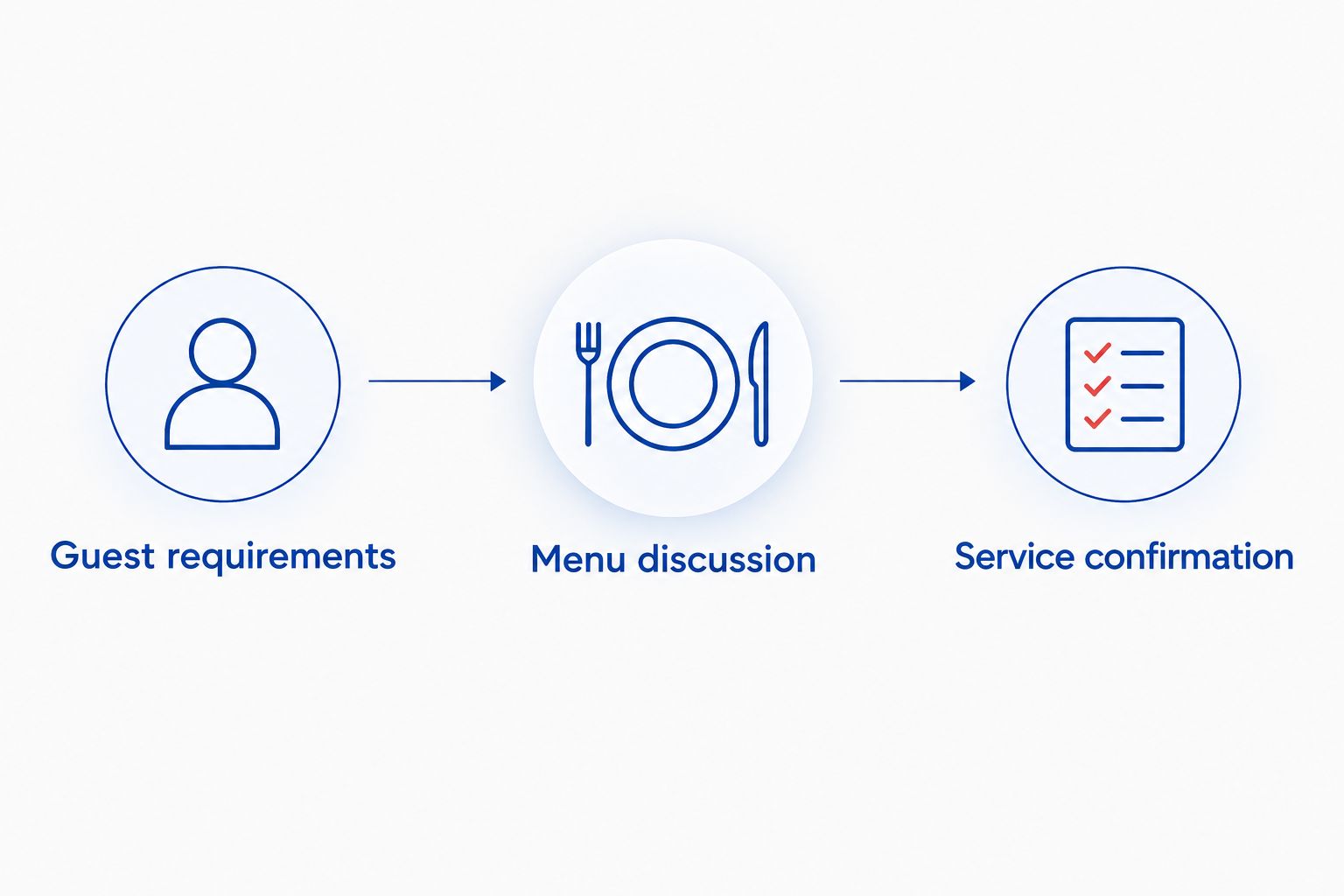
A useful brief connects your guests' requirements with the way you want the wedding to feel. Use these 3 planning steps before settling on a menu.
Guest requirements
Collect requirements directly from guests rather than interpreting shorthand on an RSVP. Distinguish vegan preferences, gluten avoidance, coeliac disease and allergies without asking guests to share medical details publicly.
Record who needs both vegan and gluten-free food. Those requirements should not become separate lists that lose their connection to the same person.
Menu discussion
Explain your preferred dining atmosphere and ask which serving approaches the caterer can support. Request a discussion of the whole meal, including accompaniments and later food service.
For a 2026 enquiry with Fork + Farm, share the date, venue, expected guest count and known requirements. Ask what needs to be settled before a proposed menu can be confirmed.
Service confirmation
Resolve 2 distinct confirmations: what goes into the food, and how the food reaches the correct guest. Both matter.
Include transport, holding, preparation space and serving arrangements in the discussion. Ask the venue and caterer to identify who owns each part of that process.
Keep the written brief with your other wedding decisions. When a requirement changes, update the person responsible for the menu and the person responsible for service; one conversation does not necessarily reach both.
Start your wedding catering conversation
Share your venue, celebration plans and dietary requirements to discuss the next steps.
How the ideas are ranked
The 2026 ranking prioritizes a complete meal, ingredient clarity, understandable service and the experience at the table. The shared menu concept leads because it places inclusion at the beginning of menu planning.
The remaining approaches answer different needs. Plated meals prioritize assignment; stations prioritize guided choice; family-style service prioritizes sharing; coordinated evening service extends the planning beyond dinner.
No serving style establishes dietary suitability on its own. That decision rests on the specific ingredients and arrangements the caterer confirms.
Which approach should you choose?
Start with a shared menu concept, then choose the serving style around your guests' requirements. If individual identification is the deciding factor, discuss plated meals first. If guests value interaction, explore attended stations without treating them as automatically suitable.
For 2026 wedding planning, ask Fork + Farm to discuss what is possible for your particular celebration. A warm welcome begins with listening, and a useful enquiry gives the caterer something specific to respond to.
FAQ
What’s the best vegan catering idea for a Calgary wedding?
A shared vegan menu concept is a useful starting point because it makes inclusion part of the main meal. Confirm ingredients, other dietary requirements and service arrangements before choosing dishes.
Is vegan wedding food automatically gluten-free?
No, vegan food is not automatically gluten-free. Vegan dishes can contain wheat, barley or rye, so each dish requires a separate gluten review.
Can a wedding meal be both vegan and gluten-free?
Yes, a meal can be designed to meet both requirements. Its suitability depends on the ingredients and on preparation and service arrangements, especially for guests with coeliac disease or allergies.
Is plated service better than a buffet for dietary requirements?
Plated service provides a clearer way to assign a specific meal to a named guest. It does not establish safe preparation by itself; discuss kitchen procedures and meal identification separately.
What should I ask about gluten cross-contact?
Ask how ingredients, preparation surfaces, equipment, transport and serving utensils are managed. Explain whether the guest has coeliac disease or another requirement so the caterer can respond to the actual need.
What should I include in a wedding catering enquiry?
Include your wedding date, venue, expected guest count, preferred dining style and known dietary requirements. Explain which guests need both vegan and gluten-free food rather than treating those as unrelated requests.
Can Fork + Farm provide the menu ideas in this guide?
Discuss each proposed idea directly with Fork + Farm before including it in your wedding plans. The company provides full-service, from-scratch wedding catering, but this guide does not confirm specific dishes, dietary accommodations or date availability.
One last thing
Follow one guest's meal through the entire evening on paper. Check the welcome food, dinner, dessert and late-night service, including who answers questions at each stage.
For your 2026 planning notes, this is more useful than a single dietary label beside a name. It turns a good intention into specific conversations—and helps you picture a celebration where every guest feels remembered.
Related guides
- Catering ideas for small and intimate Calgary weddings
- Catering options for Calgary wedding venues
- Dessert and late-night catering ideas for Calgary weddings


